IELTS
IELTS Exam
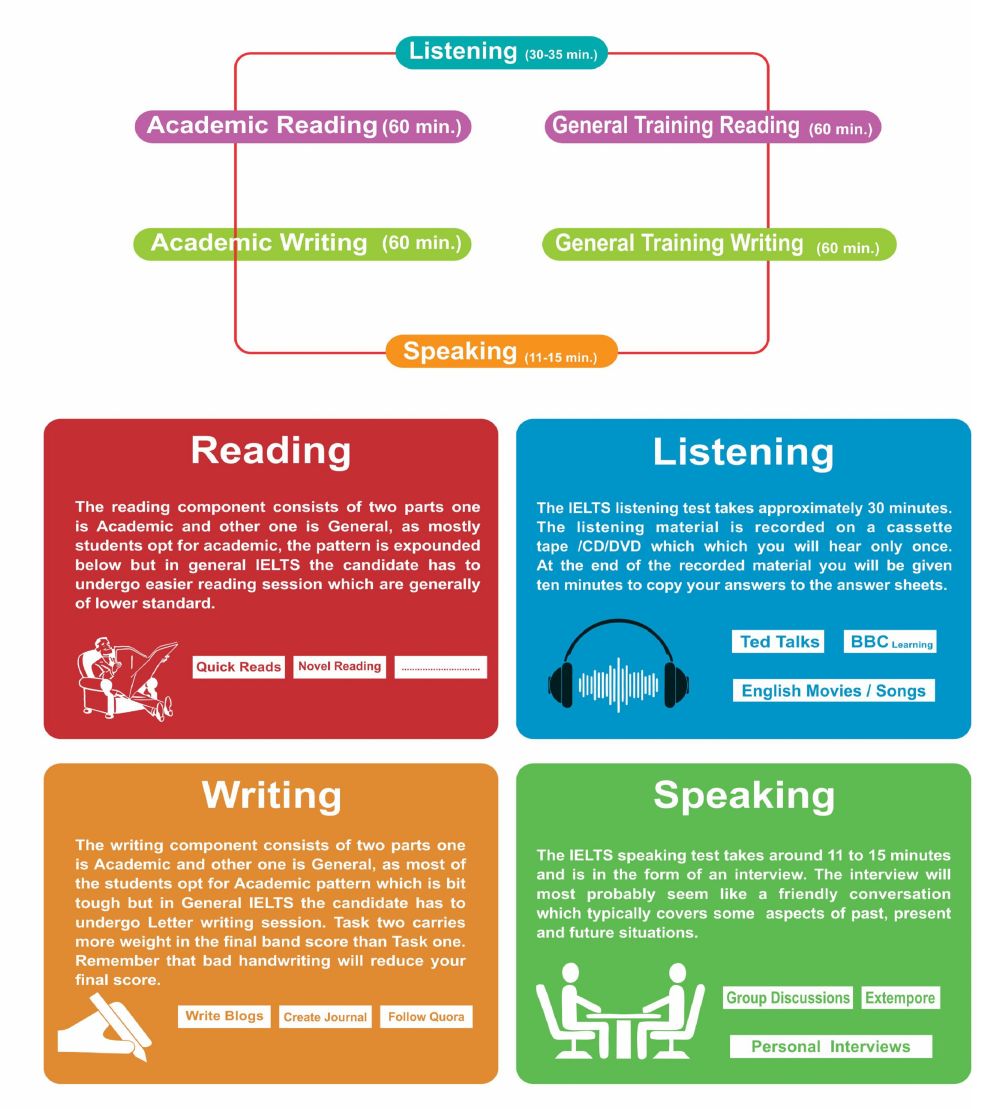
The IELTS test surveys your capacities in tuning in, perusing, composing and talking – in under three hours. There are two kinds of IELTS: Academic and General Training. ... The Listening, Reading and Writing segments of all IELTS tests are finished around the same time, without any breaks in the middle of them.
IELTS Exam Types
IELTS Academic
IELTS General Training
There are two kinds of IELTS: Academic and General Training. Tuning in and Speaking are the equivalent for the two tests, however, the topic of the Reading and Writing segments varies relying upon which test you take.
The Listening, Reading and Writing areas of all IELTS tests are finished around the same time, without any breaks in the middle of them.
The Speaking area, nonetheless, can be finished as long as seven days prior to or after different tests. Your test place will exhort.
The complete test time is 2 hours and 45 minutes.
Listening:
You will listen to four recordings of native English speakers and then write your Answer.
Recording 1: A conversation between two people set in every social context.
Recording 2: A monolog set in a regular social setting, for example, a discourse about neighborhood offices.
Recording 3: A discussion between up to four individuals set in an instructive or preparing setting, for example, a college mentor and an understudy talking about a task.
Recording4: A monolog on a scholastic subject, for example, a college address.
Assessors will be searching for proof of your capacity to comprehend the fundamental thoughts and itemized true data, the feelings and perspectives of speakers, the motivation behind an articulation and proof of your capacity to follow the advancement of thoughts.
Paper Format
There will be four parts with 10 questions.
The initial two sections manage circumstances set in regular social settings. In Part 1, there is a discussion between two speakers (for instance, a discussion about movement courses of action), and in Part 2, there is a monolog in (for instance, a discourse about nearby offices). The last two sections manage circumstances set in instructive and preparing settings. In Part 3, there is a discussion between two fundamental speakers (for instance, two college understudies in conversation, maybe guided by a mentor), and in Part 4, there is a monolog on a scholastic subject.
The chronicles are heard just once. They incorporate a scope of accents, including British, Australian, New Zealand, American and Canadian.
Approximately 30 minutes (plus 10 mins transfer time) for 40 questions. Each question worth 1 mark.
Band score Conversation
A Band Score transformation table is created for every form of the Listening test which interprets scores out of 40 into the IELTS 9-band scale. Scores are accounted for in entire groups and half groups.
One imprint is granted for each right answer in the 40-thing test. Care ought to be taken when composing answers on the appropriate response sheet as poor spelling and sentence structure are punished.
Reading:
The Reading segment comprises of 40 inquiries, intended to test a wide scope of understanding aptitudes. These incorporate perusing for essence, perusing for principle thoughts, perusing for detail, skimming, understanding legitimate contention and perceiving essayists' sentiments, mentalities, and reason.
Academic Test:
This includes three long texts which range from the descriptive and factual to the discursive and analytical. These are taken from books, journals, magazines, and newspapers. They have been selected for a non-specialist audience but are appropriate for people entering university courses or seeking professional registration.
Paper Format:
Three perusing sections with an assortment of inquiries utilizing various undertaking types.
Approximately 60 mins for 40 questions.
Writings are taken from books, diaries, magazines, and papers, and have been composed for a non-authority crowd. All the subjects are of general intrigue. They manage issues that are intriguing, conspicuously proper and open to test-takers entering undergrad or postgraduate courses or looking for proficient enrollment. The entries might be written in an assortment of styles, for instance, story, distinct or desultory/contentious. In any event, one content contains a nitty-gritty coherent contention. Writings may contain non-verbal materials, for example, outlines, charts or representations. In the event that writings contain specialized terms, a basic glossary is given.
Test takers are required to move their responses to an answer sheet during the time took into account the test. No additional time is took into consideration move. Care ought to be taken when composing answers on the appropriate response sheet as poor spelling and sentence structure are punished. Each question is of 1 mark.
Writing:
Type 1 - you will be given a diagram, table, graph or outline and requested to depict, condense or clarify the data in your own words. You might be approached to depict and clarify information, portray the phases of a procedure, how something works or depict an article or occasion.
Type 2 - you will be approached to compose an exposition because of a point of view, contention or issue. Reactions to the two assignments must be in a proper style.
Paper format:
There will be two writing Task and Both must be Completed.In Writing Task 1, test takers might be approached to depict realities or figures introduced in at least one chart, outlines or tables on a related subject; or they might be given a graph of a machine, a gadget or a procedure and requested to clarify how it functions. They ought to write in a scholarly or semi-formal/unbiased style and incorporate the most significant and the most pertinent focuses in the chart. Some minor focuses or subtleties might be forgotten about.
Test takers ought to spend close to 20 minutes on this undertaking. They are approached to compose at any rate of 150 words and will be punished if their answer is excessively short. While test-takers won't be punished for composing in excess of 150 words, they ought to recollect that a more drawn out Task 1 answer may imply that they have less time to spend on Task 2, which contributes twice as a lot to the Writing band score.
Test takers ought to likewise take note that they will be punished for unimportance if the reaction is off-point or isn't composed as full, associated content (for example utilizing visual cues in any piece of the reaction, or note structure, and so forth.). They will be seriously punished for literary theft (for example replicating from another source).
Test takers must compose their answers on the appropriate response booklet.
Speaking:
The Speaking test comprises of an oral meeting between the test takers' and an analyst. Every single Speaking test is recorded.
Timing will be 11-15 minutes.
IELTS Speaking How it is marked:
Fluency and Coherence
This alludes to the capacity to chat with typical degrees of coherence, rate, and exertion and to interface thoughts and language together to frame cognizant, associated discourse. The key pointers of familiarity are discourse rate and discourse progression. The key pointers of intelligibility are legitimate sequencing of sentences, away from of stages in a conversation, portrayal or contention, and the utilization of firm gadgets (for example connectors, pronouns, and conjunctions) inside and between sentences.
Lexical Resource
This rule alludes to the scope of jargon utilized and the accuracy with which implications and mentalities can be communicated. The key pointers are the assortment of words utilized, the ampleness and appropriacy of the words utilized and the capacity to avert (get cycle a jargon hole by utilizing different words) with or decisively.
Grammatical Range and Accuracy
This alludes to the range and the exact and proper utilization of the test-takers' syntactic asset. The key pointers of the syntactic range are the length and intricacy of the expressed sentences, the suitable utilization of subordinate conditions, and the scope of sentence structures, particularly to move components around for data center. The key pointers of syntactic exactness are the number of linguistic mistakes in a given measure of discourse and the informative impact of blunder.
Pronunciation
This foundation alludes to the capacity to create intelligible discourse to satisfy the Speaking test prerequisites. The key markers will be the measure of strain caused to the audience, the measure of the discourse which is garbled and the recognizability of L1 impact.
Comments
Post a Comment